Why documentation decides the payout
A home insurance policy only kicks in when you file a claim — and at that point the burden of proof is on you. Your insurer doesn't know what you had at home; it only knows what you show it. After a flood or burglary, most people rebuild the list from memory and name 60–70% of their belongings, remembering the rest only after the case is closed — when it's too late to add.
Flooding is one of the most common home losses, and professional restoration afterwards can easily run into thousands. At that scale, every item you can't document is a real loss out of your own pocket.
The good news: you don't have to create the documentation in a panic after the loss. A few minutes of calm work today — a list of valuable items with photos and purchase details — turns the stressful "what did I actually have" into a ready document you can send.
What your insurer wants to see
The exact documents depend on the type of loss, but almost every claim shares the same core:
- Your details and policy number — the basis for identifying the case.
- The date, nature and circumstances of the event — what happened and when.
- A list of damaged or stolen property — with quantity, value and, where possible, year of purchase.
- Proof of value — receipts, invoices or other confirmations (more on alternatives below).
- Photos — of both the damage itself and the items before the event, if you have them.
On top of that come documents specific to the type of loss:
- Burglary or robbery — a police report plus a list of stolen items with proof of purchase.
- Flooding — a report from the building manager (in a multi-unit building) or confirmation of the cause; notify the affected neighbour promptly so they can pursue their own claim.
- Fire — a fire-brigade report, if they were called.
- Power surge — an electrician's assessment of the effects plus a repair estimate or invoices.
The rule that ties it all together: the more consistent information you provide about an item at once — name with model, value, date and place of purchase, serial number, photo — the fewer follow-up questions come back to you and the faster the case closes. Scattered, partial data drags out the process and leaves room to reduce the payout.
Domowik keeps this inventory on your phone — with photos, value and purchase details — and turns it into a ready PDF report. See it on Google Play →
How to prove ownership without a receipt
The most common worry is: "I no longer have the receipt, so I'll get nothing." That's not true. A receipt is just one type of proof — not the only one. Ownership and value can be substantiated in several ways, and the more of them you gather, the stronger your position:
- A bank statement or card payment confirmation — shows the date and amount of the transaction.
- An email confirmation or order history from an online shop or auction site.
- A photo of the item — ideally in its usual place, which also documents that it was in your home.
- A serial number or nameplate — uniquely identifies the device and often lets the manufacturer verify the warranty.
- A warranty card — contains the model, date and place of purchase.
- A photo of the receipt — a copy on your phone is just as useful as a crumpled original that fades over time anyway.
In other words: even if the original receipt is long gone, a combination of a photo of the item, its serial number and a payment trail can fully substantiate that the device was yours and what it was worth. The key is gathering these elements in advance, for each item — because reconstructing them after a loss is often impossible.
Replacement cost vs actual cash value
At payout time, it matters which value the insurer uses to calculate compensation. The difference can run into thousands.
Replacement cost
Also called replacement cost, this is the amount it would cost today to buy an equivalent of the damaged item — a new device with similar specifications. Home contents insurance at replacement cost lets you restore your property in full: you receive what it actually costs to recreate the pre-loss state.
Actual cash value (ACV)
Actual cash value (ACV) is the replacement cost reduced by real wear. A washing machine bought five years ago will be valued with those five years of use factored in — the payout will be lower and probably won't cover a new one. This policy variant is cheaper, but in a loss you top up the difference yourself.
What does this mean for your documentation? Record the price and date of purchase. The date lets the insurer calculate wear and lets you check whether the valuation is fair. If you don't remember the price, enter an estimated replacement value — the amount you'd pay today for a similar device — and note that it's an estimate. An approximate value with a date is far better than an empty field.
Underinsurance: the most common reason for a low payout
This is a trap few people think about when signing a policy, yet it really cuts payouts. Underinsurance happens when the declared sum insured is lower than the actual value of your property — because it hasn't been updated in years while prices have risen in the meantime.
The result: in a total loss the insurer pays at most the declared sum, and you cover the difference. Some policies also apply an averaging (proportional) rule — if you insured your property for half its value, the payout for every loss may be reduced proportionally.
Here an inventory with a value summary gives a concrete benefit: you see the total value of your belongings and can compare it with the sum insured in your policy. If the sum is clearly lower, that's a signal to update it before a loss occurs. It's also worth remembering that policies usually have separate limits for cash, jewellery, electronics and items in attached spaces (basement, garage) — categories in your inventory show, in seconds, how much you hold in each of these groups.
How to prepare an inventory report in minutes
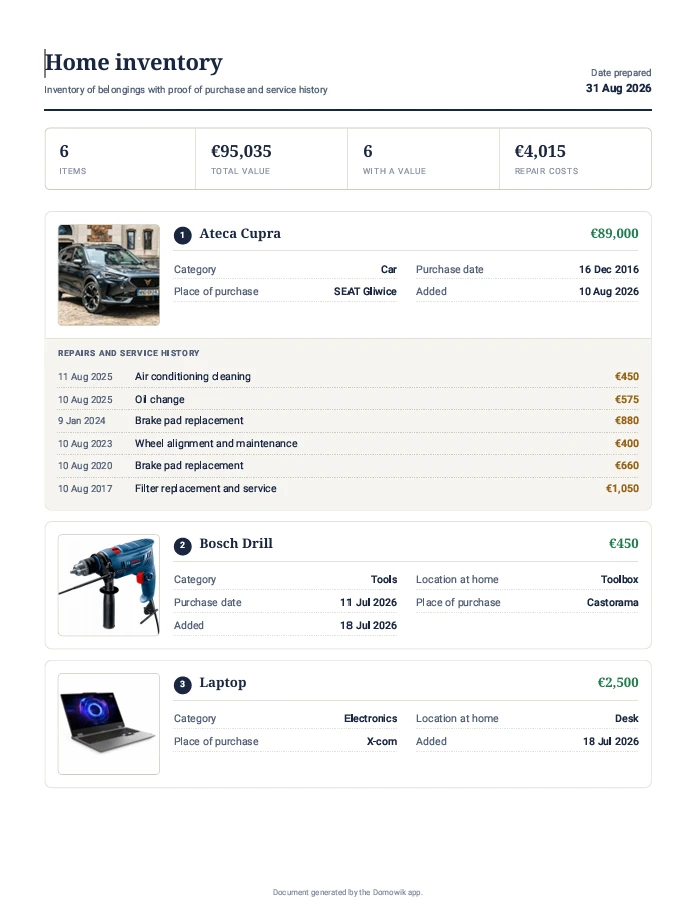 This is a ready PDF report generated with one click from Domowik — it includes the valuation, photos, proof of purchase and service history.
You can keep a list of belongings in a notebook or spreadsheet, but at the moment of a loss you need a single, clear document to send your insurer — not a pile of loose photos and notes. A good inventory report contains:
- A list of items with name, category and location.
- The value of each item plus a summary of the total value.
- The date and place of purchase and the serial number.
- Photos and receipts embedded as proof next to each entry.
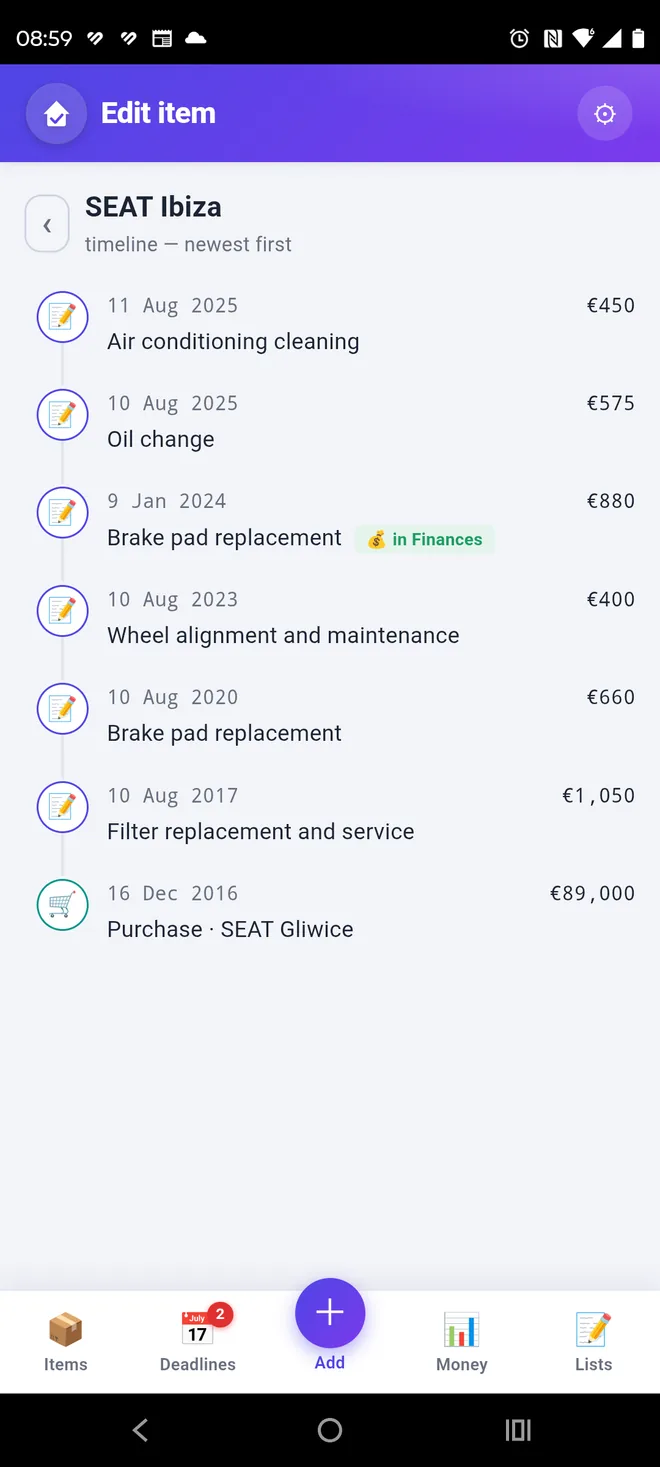
- Repair and service history — evidence that the item was maintained and still had value.
Domowik pulls all of this into a ready PDF inventory report. Next to each item you get value, dates, serial number, photo and receipt, plus a repair timeline. You create the report straight from your item list, the home screen or settings; the app opens the system print dialog, where you choose "Save as PDF". The result is a single file you can email to your insurer or attach to a claim.
How to build the inventory itself from scratch — what to record for each item and how to photograph gear — we covered step by step in the guide on home inventory.
Have your documentation ready before you need it
Domowik stores photos, value, dates and serial numbers next to every item and turns them into a PDF report — locally, without creating an account.
Get Domowik on Google Play Scan with your phone
Filing a claim step by step
The order of actions after a property loss — using flooding as an example, though the pattern is similar for other events:
- Stop the source of the loss. Turn off the water, cut the power, limit further damage. Safety first.
- Notify the building manager. In a multi-unit building, usually within 2 days of the event.
- Talk to your neighbour if the loss affects more than one unit — it lets them pursue their own claim.
- Call your insurer as soon as you discover the loss and report it. Most companies prefer a form on their website.
- Collect the reports — from a police or fire-brigade intervention, from the building manager, an electrician's assessment for a power surge.
- Draw up a list of losses with quantity, value and year of purchase. This is where a ready inventory report saves the most time.
- Don't remove damaged items before the inspection. A loss adjuster usually arrives within a few days; until then, leave things as they are and only document with photos.
- Give access for the inspection and cooperate with the assessment.
Separate, detailed scenarios — what to do immediately after a burglary or water damage (order of actions, police, shutting off the water) — are covered in a dedicated guide.
Deadlines worth knowing
Deadlines differ between companies, but the orders of magnitude are similar:
- Reporting the loss: usually 3–7 business days from the event. Check the exact deadline in your policy — missing it can reduce the compensation.
- Paying compensation: typically 30 days from the report at major insurers.
- Notice of the amount: the insurer usually informs you of the proposed sum earlier, often within about 7 days.
- Disputed portion: if part of the claim is disputed, resolving it may take an extra ~14 days, while the undisputed part is paid within the standard deadline.
The more complete the documentation that reaches the insurer up front, the fewer follow-up questions — and the closer to the lower end of these deadlines the case closes.
Common mistakes that lower the payout
- Rebuilding the list from memory. Without a prior inventory you miss 30–40% of your items — and that money you won't get back.
- Delaying the report. Exceeding the deadline in your policy can be grounds for reducing the compensation.
- Removing or repairing items before the inspection. It hampers determining the cause and scale of the loss, and without documentation it lowers the payout.
- Missing reports. For theft, fire or flooding, the absence of a police, fire-brigade or building-manager report complicates the whole case.
- A years-old value with no date. The amount alone doesn't let anyone judge the device's value today or calculate wear.
- Underinsurance. A sum insured detached from the real value of your property is one of the most common reasons a payout falls short of expectations.
- A backup only on the destroyed phone. An inventory that burned or was stolen along with everything else won't help. Keep a copy outside the home too.
One last thing: an inventory report is only as good as its copy outside the home. Export the document and store it where it will survive the loss — in the cloud, on a work computer or with family. How to safely move and archive app data, we covered in the guide on backing up before switching phones.
Frequently asked questions
Will I get compensation without receipts?
Yes. A receipt is just one of several possible proofs. Ownership and value can also be substantiated with photos, bank statements and card payment confirmations, email confirmations from shops, serial numbers and warranty cards. The more consistent the information, the simpler the case. Detailed rules differ between companies — check the terms of your policy.
What if I don't remember the purchase price?
Enter an estimated replacement value — the amount you'd pay today for a similar device — and note in a comment that it's an estimate. An approximate value with a date is far better than an empty field, because it lets the insurer calculate wear and value the loss.
How long does the insurer have to pay?
Typically 30 days from reporting the loss at major insurers. The company usually notifies you of the proposed amount earlier, and if part of the claim is disputed, resolving it may take longer while the undisputed part is paid on time. You'll find the exact deadlines in your policy.
Do photos of items before the loss matter?
Yes — it's one of the strongest proofs that an item was actually in your home, and the fastest way to fill in details after the event. A photo of a device in its usual place also documents its location, and a close-up of the nameplate or serial number lets you identify it unambiguously.
How do I check whether I'm underinsured?
Compare the sum insured in your policy with the actual total value of your belongings. If you haven't updated the sum in years while the value of your property has risen, you're probably underinsured and a large loss won't be fully covered. An inventory with a value summary gives you that reference point instantly.
Does repair history matter for a claim?
It can help. A record of services and repairs shows that an item was maintained and still worked, which supports its valuation — especially for pricier gear. It's also a handy way to remember what was repaired and when, regardless of any claim.