Why a receipt in a drawer is not enough
A receipt confirms the purchase but reminds you of nothing. It sits in a drawer or as a photo in the gallery and gets found only once the device has already broken — often weeks after the warranty expired.
The problem is not a shortage of documents but the absence of a moment when something reminds you about them. An effective system combines three elements:
- A date you have to meet.
- A reminder set early enough that you can still act on it.
- Context — what it concerns, where the proof of purchase is, who to call.
Without the third element, a reminder saying "warranty expires tomorrow" forces you to work out which device it means. Without the second, you find out about everything too late.
Which deadlines are worth tracking
Recording everything ends the same way as an over-detailed shopping list: you stop reading it. It pays to limit yourself to events whose omission genuinely costs something.
The deadlines that cost the most
| Deadline | Typical cycle | Cost of missing it |
|---|---|---|
| Vehicle roadworthiness test | every 12–24 months | penalty, no cover in the event of a claim |
| Compulsory motor insurance | every 12 months | substantial financial penalty |
| Boiler and heating system service | every 12 months | problems with a claim, safety risk |
| Home insurance | every 12 months | no cover, loss of no-claims discount |
| End of equipment warranty | 24–36 months | full cost of the repair |
| Chimney inspection | every 12 months | problems with a claim |
Cycles and legal obligations differ between countries — the values above are typical ranges worth comparing against local requirements.
Small but annoying deadlines
The second group carries no penalty, but without a reminder it usually slips your mind: replacing water and extractor filters, changing tyres, bicycle servicing, air-conditioning checks, smoke-detector batteries, renewing subscriptions and domains, extending documents.
A practical rule: if missing a deadline costs more than the two minutes it takes to record it, record it. Everything else is noise.
Domowik tracks deadlines like these and links them to the specific item. View on Google Play →
Manufacturer's warranty and your statutory rights
Many people track only the manufacturer's warranty, unaware that a faulty product usually gives them two separate routes to a remedy.
The warranty
This is a voluntary commitment from the manufacturer or seller. Its length and scope are set out in the warranty card — most often 24 months, sometimes 12 or 36, and longer for certain components. Claims normally go to a service centre named by the manufacturer.
Rights under the law
Regardless of any warranty, consumers have rights against the seller that come from legislation. In the European Union the minimum period of seller liability for goods not conforming to the contract is two years from delivery, and individual countries may provide more generous terms. The name of this mechanism and its detailed rules vary between jurisdictions, and claims are directed at the shop where the purchase was made.
The practical conclusion for a reminder system: record the purchase date, not just "warranty end". Both periods run from it, and it is the reference point in any dispute.
Before you file a complaint, check the rules that apply in your country — time limits, the scope of your rights and the procedures all vary and change over time. National consumer protection bodies are a useful starting point if anything is unclear.
How far ahead to set the reminder
The most common mistake is a reminder set for the day of the deadline. The information arrives when nothing can be done about it.
The lead time should match how long the task actually takes to arrange:
- 7 days — things you can handle immediately: changing a filter, a small purchase, a payment.
- 14 days — anything needing an appointment: a roadworthiness test, bicycle service, air-conditioning check.
- 30 days — matters that involve comparing offers: home insurance, motor insurance, subscriptions.
- 60 days — the end of a warranty on expensive equipment. That margin gives you time to check the device works properly and report a fault while it is still covered.
A trick for warranty expiry: set the reminder 60 days ahead with the text "check everything works". Many faults develop gradually — a faint noise from the washing machine or a fridge cooling less effectively is far easier to report before cover ends than after.
What to put in the note
A reminder with nothing but a name forces you to hunt for details at the exact moment you need to act. A few lines in the note save a quarter of an hour.
- Document number — policy, contract or service order.
- Contact — phone number for the service centre, garage or agent.
- What to bring — proof of purchase, warranty card, the previous report.
- Where the original is — "folder in the wardrobe, divider 3".
- Last year's amount — a reference point when negotiating or comparing offers.
Recurring deadlines
Most important deadlines come round every year. Setting them again from scratch each time is the simplest route to missing one — forget to add the next date just once and it is gone.
Recurring deadlines are worth setting for: roadworthiness tests, motor insurance, home insurance, boiler and chimney inspections, changing tyres (twice a year), air-conditioning checks, filter replacements, annual fees and subscriptions.
Check the next date after completing a task
This is where errors most often creep in. After ticking a deadline off, glance at whether the next date has been set correctly — particularly for anything that is not exactly annual, such as an inspection every 18 or 24 months.
Linking a deadline to an item
A reminder saying "warranty ends" without naming the device is close to useless — especially a year later, when nobody remembers what it referred to.
When a deadline is linked to a specific thing, the reminder gives you immediate access to the purchase date and place, the value, photos of the rating plate and any notes. If something fails, everything is in one place and filing a claim takes minutes rather than an evening spent looking for the receipt.
That does of course require the equipment to have been recorded first. How to do that efficiently, without cataloguing every last trinket, is covered in our guide to creating a home inventory step by step.
Setting the system up in one evening
The whole system can be running in about an hour. The order that works best:
- Write out the deadlines from memory (10 min). Car, home, boiler, subscriptions. That usually comes to 6–10 entries.
- Find the documents (20 min). Policies, warranty cards, inspection reports. While you are at it, photograph any you do not have in digital form.
- Enter the deadlines with lead times and notes (20 min). Start with the most expensive consequences: motor insurance, roadworthiness test, home insurance, boiler.
- Set the recurrence (5 min) for everything that comes round annually.
- Add warranties while you are there (5 min) — for now only for the most expensive items bought in the last two years.
After that evening the system is running. New deadlines get added one at a time, as you buy things.
Set your first reminders in minutes
In Domowik a deadline can be linked to a specific item, so the reminder arrives with the purchase date and documents attached.
Get Domowik on Google Play Scan with your phone
Common mistakes
- A reminder on the day itself. The information arrives when you can no longer react. Lead time should match how long the task takes to arrange.
- A deadline with no context. "Warranty" or "inspection" without saying what it covers forces you to go searching at the worst possible moment.
- Recording only the warranty end date. The purchase date matters more — statutory rights run from it too.
- Retyping deadlines manually every year. One lapse and the deadline disappears from the system for good.
- Not checking the date after ticking something off. For cycles other than annual, the next date often lands somewhere other than you assumed.
- Recording everything. Thirty reminders a month means you stop reading them, including the important ones.
- Relying on memory for equipment under warranty. Two years is far too long to remember when you bought a washing machine.
How Domowik can help
This kind of system can be run in a phone calendar, and for some people that is enough. The calendar's limitation is that an event is not connected to the thing it concerns — the date exists separately from purchase details and photos.
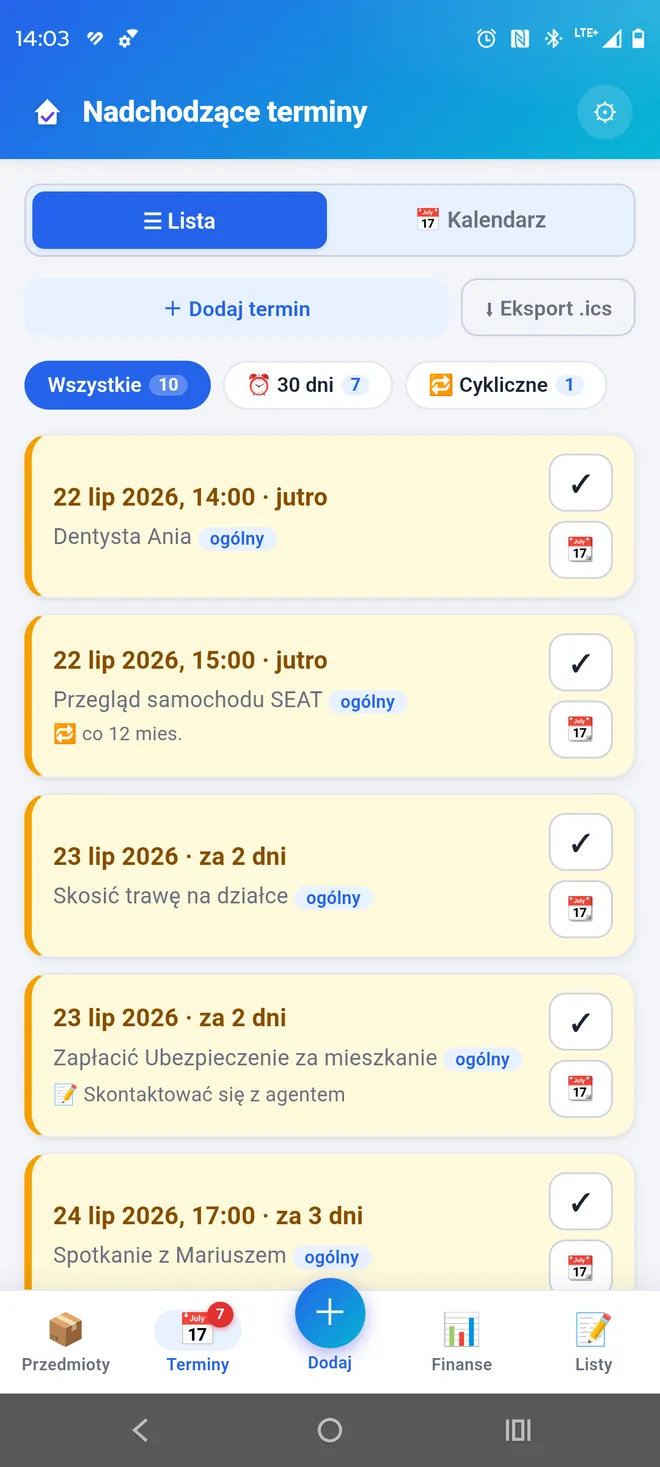
In Domowik, deadlines can be general or assigned to a specific item, which supplies the context described above. There is a list view of upcoming matters and a monthly calendar view, and notifications work locally on the device. Deadlines can be exported to an ICS file, and an individual deadline can be passed to Google Calendar if you prefer to have it there as well.
Data stays on the device and does not sync automatically, so it is worth making a copy before changing phones — covered separately in our guide to backing up app data before changing phones.
Frequently asked questions
How far ahead should I set a warranty expiry reminder?
Around 60 days before it runs out. That margin lets you check the device works flawlessly and report any fault while cover still applies. For things you can settle immediately, 7–14 days is enough.
Is an ordinary phone calendar enough?
For the reminding itself, yes. A calendar does not, however, hold purchase details, photos of documents or a link to the specific device, so once the reminder arrives you still have to look for the details elsewhere.
How does a manufacturer's warranty differ from statutory rights?
A warranty is a voluntary commitment from the manufacturer or seller, described in the warranty card. Separately from it, consumers have rights against the seller under legislation — in the European Union the minimum is two years from delivery, with details varying by country. Both run from the purchase, which is why that date is worth recording.
What if I have lost the receipt?
Check whether the purchase shows up in your card payment history, in emails from the online shop, or in your account with the retailer. For equipment under a manufacturer's warranty, the serial number often helps. A photo of the receipt taken on the day of purchase solves this problem in advance.
How do I avoid drowning in notifications?
Record only the deadlines whose omission genuinely costs something — money, time or safety. Small, repetitive tasks are better combined into one seasonal reminder than given individual entries.
Is it worth moving deadlines into Google Calendar?
If you plan your day mainly in Google Calendar, passing important deadlines there can be convenient. Bear in mind that the data then leaves your device and becomes subject to the rules of an external service.